Ontario winters average 123 frost days and end with a destructive freeze-thaw period that damages cool-season lawns in five distinct ways — each requiring a different fix. This field guide covers exactly how to identify and recover from each one before the May season opens.
Every spring in North York, Vaughan, Richmond Hill, Markham, and Scarborough, homeowners step outside after the last snow and discover their lawn looks nothing like it did in October. Brown patches. Matted grey circles. Tracks running across the yard. Salt-scorched strips near the driveway.
Some of this damage is minor and self-correcting. Some of it requires active intervention before the growing season begins. The mistake most homeowners make is treating all winter damage the same way — or worse, doing nothing and waiting to see what comes back. The right approach depends on precisely which type of damage you're dealing with, because each has a different cause, a different recovery window, and a different fix.
This guide covers all five forms of winter lawn damage common to Ontario's climate zone — with identification criteria, soil temperature thresholds, step-by-step recovery protocols, and a clear framework for deciding when to overseed versus when to call in professional spring cleanup services.
Why GTA Winters Are Uniquely Hard on Cool-Season Lawns
The Greater Toronto Area sits in a climatic transition zone that subjects lawns to conditions more damaging than either consistently cold or consistently mild winters. According to Environment and Climate Change Canada's climate data, Toronto averages 123 days per year with minimum temperatures at or below 0°C, but the more destructive characteristic is the high number of freeze-thaw cycles — days where temperatures cross the 0°C threshold in both directions.
GTA lawns are predominantly Kentucky Bluegrass (Poa pratensis), Creeping Red Fescue (Festuca rubra), and Perennial Ryegrass (Lolium perenne) — cool-season species that go dormant but maintain living crowns throughout winter. Those crowns tolerate deep, stable cold well. What they struggle with is repeated partial thawing: water enters the crown cells, refreezes, and causes cellular rupture. This explains why a GTA lawn after a volatile winter (frequent freeze-thaw cycles) often looks worse than one after a hard, consistently cold winter with stable snow cover.
The role of clay soil in GTA winter damage
North York, Markham, and much of the GTA sit on glacial lake-bed clay — a soil type that holds water, drains poorly, and heaves significantly during freeze-thaw cycles. This amplifies every form of winter damage: poor drainage means standing water that freezes and smothers turf; heaving displaces grass crowns; slow spring drainage delays the soil temperature thresholds needed to begin recovery work.
The 5 Winter Damage Types on GTA Lawns
1. Snow Mould (Gray & Pink)
Snow mould is the most common form of winter lawn damage in Ontario and the one most frequently misidentified as dead grass. It is caused by two fungal pathogens with different visual signatures and different treatment requirements. The University of Guelph Turfgrass Institute — the leading turfgrass research body in Ontario — identifies both as the primary post-winter fungal diseases affecting cool-season GTA lawns.
| Type | Pathogen | Appearance | Recovery |
|---|---|---|---|
| Gray Snow Mould | Typhula spp. | Straw-coloured patches 8–30 cm across, grey mycelium at edges in cool wet weather | Rake; crown usually alive — recovers without seeding in 3–4 weeks |
| Pink Snow Mould | Microdochium nivale | Salmon-to-pink edge colouring, water-soaked look, can occur without snow cover | Rake, improve drainage; may need overseeding if crown is dead (squeeze test) |
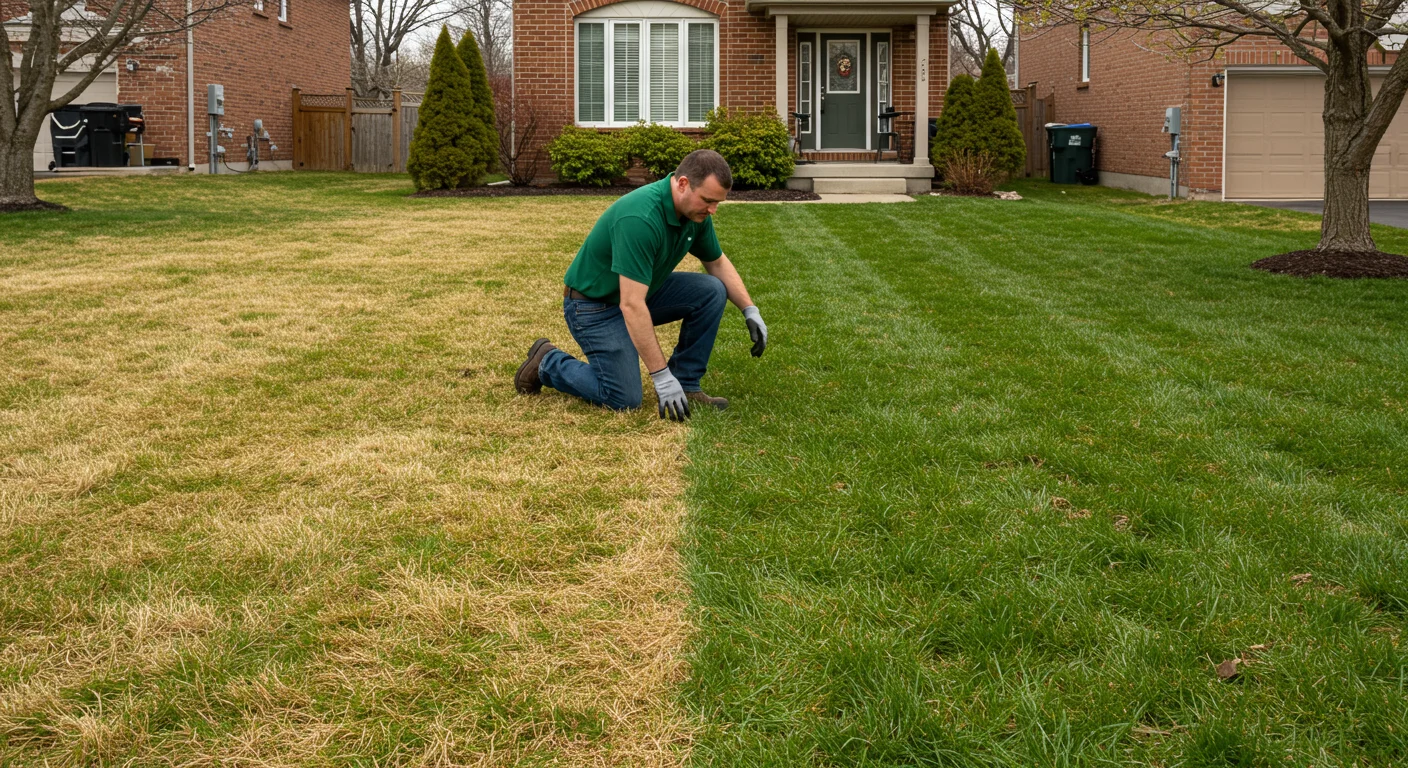
The crown squeeze test: Pinch a blade from the centre of a mould patch and gently tug. If the crown (the white growing point at the base of the blade, just below soil level) slides out intact without resistance, the plant is dead and you'll need to overseed. If the crown holds and resists pulling, the plant is alive and will recover with improved air circulation.
Recovery Protocol: Snow Mould
- Lightly rake affected areas with a spring-tine rake to break up matted grass and improve air circulation
- Do not fertilize immediately — nitrogen accelerates fungal spread in cool, wet conditions
- Wait for soil temperature to reach 10°C before applying any fertilizer
- Overseed dead patches at 35–45 g/m² with a matching cultivar mix once nighttime temps are consistently above 5°C
2. Salt Damage (Road Salt & Ice Melt)
Road salt (sodium chloride) and calcium-magnesium acetate ice melts damage grass through two separate mechanisms: osmotic dehydration (salt draws water out of plant cells) and sodium toxicity to soil structure. In clay-heavy GTA soils, sodium ions displace calcium and magnesium from soil particles, causing the clay to disperse and the surface to seal — preventing air and water from reaching the root zone even after the salt itself has been diluted.
Identification: Salt damage follows a distinct geographical pattern — it appears in uniform strips or bands paralleling sidewalks, driveways, and road edges. The boundary is usually sharp. The grass bleaches to a grey-tan colour, dries out, and pulls cleanly from the soil because the roots have desiccated. Compare this to snow mould, which appears in irregular circular patches unrelated to hardscape edges.
Recovery Protocol: Salt Damage
- Flush first: Apply 3–5 cm of water over 2–3 consecutive days to leach chloride ions below the root zone (top 15 cm)
- Apply gypsum (calcium sulphate): 2–4 kg per 10 m² to displace sodium ions from clay particles and restore soil structure — this step is critical for GTA clay soils and often skipped by DIYers
- Rake out dead grass exposing bare soil
- Overseed with salt-tolerant species: Tall Fescue or Perennial Ryegrass perform better in high-salt zones than Kentucky Bluegrass
- If over 40% of the strip is bare, sodding with a Tall Fescue mix gives faster results (2–3 weeks vs. 6–8 weeks for seed)
3. Frost Heaving & Winter Kill
Frost heaving occurs when soil water freezes and expands, physically pushing grass crowns above the soil surface. Once exposed, these crowns are vulnerable to desiccation by wind and sun, and die even when temperatures return to normal. This is a form of winter damage that appears on otherwise healthy turf with no disease involvement.
Identification: Heaved areas show a characteristic texture — the soil surface looks rough, cracked, and raised in irregular patches, with grass crowns visible above the soil line and sometimes loose soil clumps around the base of plants. The surrounding turf is often fine. Heaving is more common in areas with poor drainage, compacted soil, or slope transitions where water accumulates before freezing.
Recovery Protocol: Frost Heaving
- Wait until soil is no longer frozen at depth (mid-April typical for GTA)
- Lightly roll the area with a lawn roller filled to 1/3 capacity — heavy rolling compacts clay and causes long-term damage
- Press any partially heaved crowns back to soil level with the heel of your boot on dry days
- Top-dress with fine compost at 5–8 mm to fill air pockets without smothering turf
- Apply core aeration in early May to address the underlying drainage issue that caused heaving
4. Vole Tunnels (Meadow Mouse Runways)
Meadow voles (Microtus pennsylvanicus) are among the most common but least-recognized causes of spring lawn damage in the GTA. The Ontario Ministry of Agriculture, Food and Rural Affairs (OMAFRA) notes that vole populations peak every 3–5 years in Ontario, with particularly active winters following mild autumns with early snow cover. Voles tunnel and feed under snow cover all winter, invisible until the snow melts. They eat grass blades and crowns, creating surface runways — winding channels of closely cropped or bare grass typically 3–5 cm wide.
Identification: Unlike moles (which create raised ridges and soil mounds), voles create winding surface channels that are matted or completely bare. These channels often lead from garden beds or woodpiles toward the centre of the lawn. If you look closely at the edges of the runway, you will see grass blades with clean diagonal bites.
Recovery Protocol: Vole Tunnels
- Rake the runways with a stiff metal rake to pull up matted debris and loosen the compacted soil in the channel
- Lightly top-dress the channels with a soil/compost blend
- Overseed the runways in early May — if crowns were eaten, the grass will not regrow without new seed
- For immediate results, cut narrow strips of sod to fit the channels (the "surgical repair" method)
5. Ice Sheet Compaction & Suffocation
Ice sheet damage occurs when standing water freezes into a solid, clear layer over the lawn for more than 40–60 consecutive days. This layer prevents gas exchange (oxygen entering and CO2/methane leaving) and can lead to crown death from anoxia (oxygen starvation). This is particularly common on GTA properties with poor surface grading or low spots against foundation walls.
Identification: Ice damage appears as large, amorphous patches of slimy, dead, or very slow-to-green grass. These patches almost always correspond to the lowest points on the property where winter ponding occurred. The grass often looks "smeared" or matted against the soil surface once the ice melts.
Recovery Protocol: Ice Damage
- Check crowns for life (the squeeze test) — ice-damaged crowns are often completely dead
- Perform core aeration as soon as soil is dry enough to support machinery to improve gas exchange
- Vertical mow (dethatch) the affected area to remove dead, matted material
- Overseed or sod-replace based on the percentage of bare soil
- Consider long-term grading improvements to prevent future ponding
Frequently Asked Questions
What does snow mould look like on a GTA lawn?
Snow mould appears as roughly circular patches of matted, bleached-out grass ranging from 8 to 30 cm in diameter. Gray snow mould (Typhula spp.) appears straw-coloured with grey mycelium visible at the edges in cool, damp conditions. Pink snow mould (Microdochium nivale) shows salmon-to-pink colouring at the margin. Both types appear shortly after snowmelt, typically in late March or April in the GTA.
When is it safe to start spring lawn work in the GTA?
It is safe to begin light spring lawn work (raking, debris removal) in the GTA when soil temperatures reach 5°C consistently and surface water has drained. This typically occurs between April 15 and May 1 depending on the year. Avoid walking on or working wet clay soil — if your footprint sinks more than 1 cm, wait another 5–7 days. Heavy work like dethatching and overseeding should wait until soil temperatures reach 8–10°C, which typically aligns with late April to early May in North York and Scarborough.
How do you fix salt damage on grass near a driveway or sidewalk?
Salt damage on grass near driveways and sidewalks is fixed by first flushing the affected area with 3–5 cm of water over 2–3 days to leach chloride ions from the soil. Then rake out dead grass, apply gypsum (calcium sulphate) at 2–4 kg per 10 sq metres to displace sodium from the clay, and overseed with a salt-tolerant cultivar such as tall fescue or perennial ryegrass. If more than 40% of the area is bare, sodding is faster than seeding for salt-damaged GTA lawns.
What are the signs of vole damage on a lawn?
Vole (meadow mouse) damage on a lawn appears as a network of winding surface runways, typically 3–5 cm wide, where the grass has been eaten down to the crown or completely removed. Unlike mole damage, vole tunnels are visible on the soil surface — not raised ridges — and connect to small burrow openings roughly 4 cm in diameter near garden beds or foundation plantings. Vole activity is most visible after snowmelt in March or April. The grass alongside runways often recovers on its own within 4–6 weeks if the crowns are intact.
Should I overseed or replace sod on winter-damaged GTA lawn areas?
The decision between overseeding and sod replacement for winter-damaged GTA lawns depends on two factors: the percentage of bare area and the type of damage. If less than 30% of a zone is bare and damage is uniform (snow mould, vole runs), overseeding with matching grass seed at 35–45 g per sq metre in late April or early May provides a full recovery by July. If more than 40% of an area is bare, if salt or chemical damage has altered soil chemistry, or if the area is high-traffic and visibility matters, sod installation provides results in 14–21 days versus 45–60 days for seed.
How much does professional spring lawn cleanup cost in Toronto?
Professional spring lawn cleanup in Toronto and the GTA costs between $149 and $349 for a typical residential property, depending on lot size and the extent of winter damage. A standard spring cleanup (debris removal, raking, dethatching, bed edging, blowing) for a 2,500–4,000 sq ft lot runs approximately $149–$395. Properties with heavy leaf accumulation, extensive snow mould, or damage requiring overseeding add $75–$200. Trim Gym Lawn Care's spring cleanup service starts at $149 and includes all standard recovery steps.