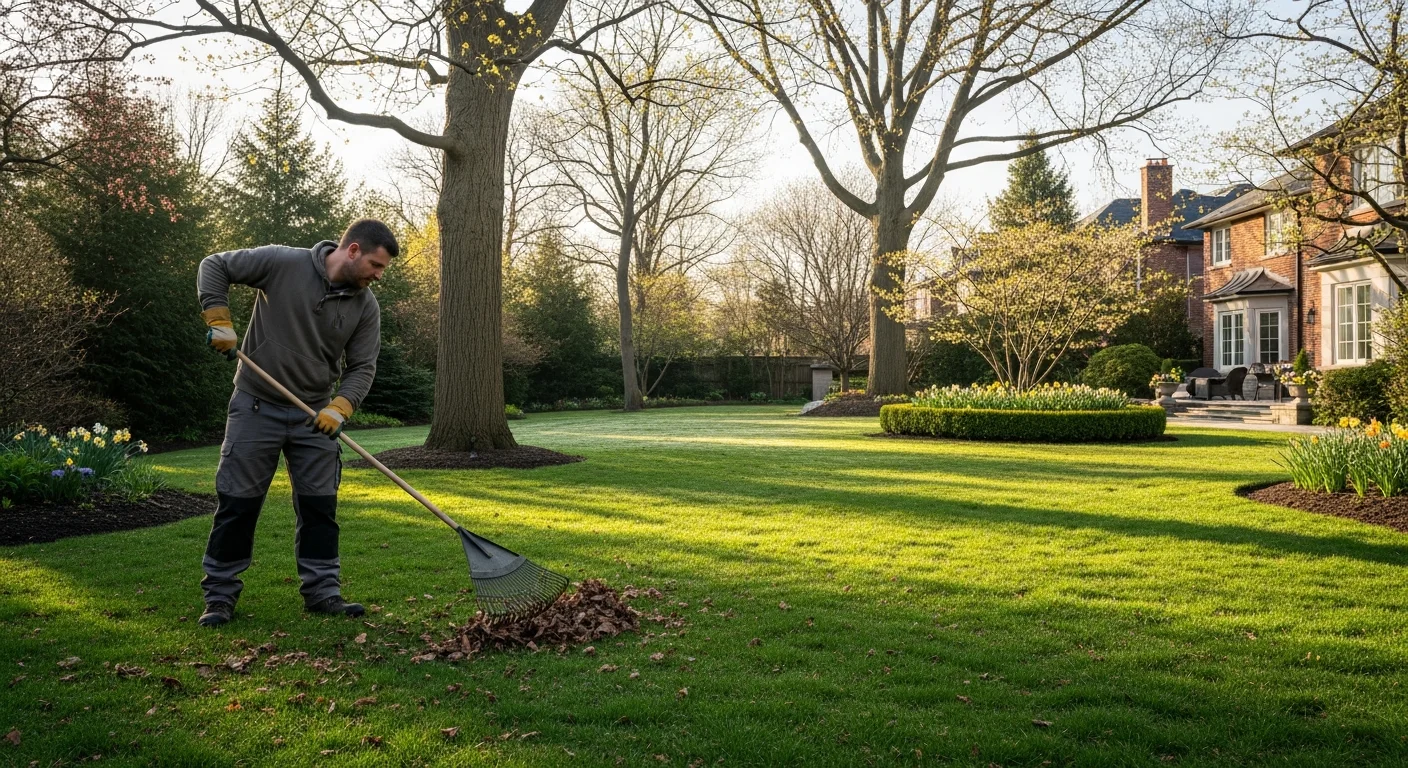
A professional spring cleanup includes debris removal, dethatching, edge re-definition, garden bed cleanup, the season's first mow, a property health inspection, and haul-away. In the GTA, the ideal window is mid-April to mid-May — the exact dates vary by city and soil type.
Every spring, thousands of GTA homeowners wait a week too long, step on their lawn too early, or skip steps that cost them all summer. This guide covers exactly what a thorough spring cleanup involves, why each task matters, and — critically — the precise timing window for North York, Scarborough, Vaughan, Markham, and Richmond Hill. Timing is based on soil temperature data from Environment and Climate Change Canada and ground-condition observations by our crews across the GTA.
What's Included in a Professional Spring Cleanup
A legitimate spring cleanup isn't a single task — it's a sequence of eight coordinated steps. Here's what should happen on your property.
Debris & Dead Leaf Removal
Every corner of the lawn is raked to pull up matted leaves, twigs, acorns, and winter debris that suffocate new grass shoots. Bagged and removed from your property.
Dethatching / Power Raking
A power rake or dethatcher strips out the dead layer of thatch — compacted organic matter sitting at the soil surface — that blocks water, nutrients, and air from reaching grass roots.
Lawn Edge Re-Definition
Bed borders, driveway edges, and walkway perimeters are cut back to a clean, sharp line. This single step makes the entire yard look 10× more manicured.
Garden Bed Cleanup
Perennials are cut back to soil level, dead annuals pulled, and winter mulch turned or removed so tender new growth can emerge unobstructed.
First Mow of the Season
The season's first cut sets the tone. Pros mow high (3–3.5 inches) to encourage deep rooting and avoid shocking dormant grass. Grass clippings are mulched back in or collected depending on thatch risk.
Soil & Lawn Health Assessment
A good cleanup crew walks the property looking for snow mould patches, salt-damaged strips, compaction zones, bare spots, and drainage problems before they become expensive repairs.
Hard Surface Clearing
Driveways, interlocks, and walkways are blown clear of sand, gravel, leaves, and winter grit that has migrated onto the lawn.
Debris Haul-Away
All raked material, cut-back stems, and collected leaves are bagged and removed. Nothing is left in a pile on the street.
Not all "spring cleanups" are equal. Some crews only rake and blow — they skip dethatching, edge work, and the health assessment. Ask specifically what's included before you book. Trim Gym's spring cleanup service includes all eight steps above.
Related Guide
What Tools Do Pros Use for Spring Cleanup?
From power rakes to core aerators — learn what each tool does and why it matters for GTA lawns.
Read the Tools GuideWhen to Do Spring Cleanup — By City
The GTA isn't a monolith. Soil type, lake proximity, and elevation all shift the ideal cleanup window by days — sometimes more than a week. Here's what to know about your specific area.
The Ontario government's lawn care guide recommends waiting until soil temperature is consistently above 8°C before doing any intensive spring lawn work — a threshold you can track at climate.weather.gc.ca using Ontario soil temperature normals.
Soil type: Heavy clay
- Clay soil in North York holds moisture well into spring — wait until it no longer sticks to your boots before working it.
- Mature tree canopies (Willowdale, Bayview Village) trap more leaves; plan for extra raking time.
- Snow mould is common under large trees — inspect and treat before the first mow.
- Ideal soil temp trigger: consistently above 8°C (use a $10 soil thermometer).
Book by April 10 to get the prime window.
Soil type: Mixed clay-loam near The Bluffs, sandier inland
- Lake Ontario's cool air pushes cleanup timing slightly later than North York — especially in Guildwood and Cliffcrest near the lake.
- Salt damage from the Gardiner and Kingston Road corridors often shows up as brown, dead strips along the lawn's edge.
- Inland areas (Malvern, Agincourt) warm up faster — those properties can often start 5–7 days earlier.
- Drainage problems are common in low-lying Scarborough lots; early inspection catches issues before they worsen.
Lake-effect cold can delay cleanup — stay flexible with your booking.
Soil type: Clay, with sandier spots in Kleinburg estates
- Vaughan's newer communities (Vellore Village, Maple) often have shallow topsoil over builder clay — compaction recovery takes priority.
- Kleinburg estate properties with large lots need full dethatching — thatch builds up faster on dense Kentucky Bluegrass.
- Interlock driveways and stone borders need careful edging to avoid chipping — use a manual half-moon edger near stonework.
- Soil typically ready to work by April 20 in most parts of Vaughan.
Estate lots book fast — April appointments fill by late March.
Soil type: Heavy clay in Markham Village, newer sandy loam in Cornell
- Unionville's heritage properties often have mature trees and dense thatch — double-pass power raking is common.
- Cornell's newer sod lawns (post-2015 builds) are shallower and need gentler dethatching — aggressive tines can pull up new sod.
- Greensborough and Berczy Village: watch for frost heaving in April — soil may still be lifting in low spots.
- Good rule: if you can push a screwdriver 6 inches into the soil without forcing it, the ground is ready.
Markham's spring is busy — book by first week of April.
Soil type: Sandy loam in Oak Ridges, clay in Bayview Hill and South Richvale
- Oak Ridges Moraine's sandy loam drains fast and warms up first — Oak Ridges and Jefferson can start cleanup 5–7 days earlier than the rest of Richmond Hill.
- Bayview Hill and Mill Pond have heavier clay soil and retain cold longer — wait until end of April.
- South Richvale properties with formal gardens need more precise bed cleanup — perennials here are often more established and require careful cutting.
- North Richmond Hill (near Elgin Mills) can hold snow patches until mid-April some years — never rush past frost.
Sandy Oak Ridges lots need less wait time — a real advantage for early bookers.
Spring Cleanup Timing: Do's and Don'ts
Do
- Wait until soil is no longer waterlogged (the boot test: no sticking)
- Confirm soil temp is 8°C+ before fertilizing after cleanup
- Mow high on the first cut — never below 3 inches
- Rake before the first mow, not after
- Book 3–4 weeks ahead for prime April/May slots
Don't
- Don't start cleanup while soil is still frozen below the surface
- Don't use a power rake on new sod under 2 years old
- Don't rush the first mow — scalping stresses dormant grass
- Don't blow clippings back onto newly cleaned beds
- Don't bag grass on the first 3 mows if thatch is low — mulch it
DIY Spring Cleanup vs. Hiring a Pro
Most GTA homeowners can handle basic raking. But power raking, edge re-definition, and the property assessment are where experience shows up in the final result. All yard waste collected during a spring cleanup must be bagged according to City of Toronto yard waste collection guidelines (or your local municipality's equivalent for Vaughan, Markham, Richmond Hill, and Scarborough).
| Task | DIY | Professional |
|---|---|---|
| Debris removal | ✓ Easy | ✓ Faster, haul-away included |
| Dethatching | △ Rental required (~$80/day) | ✓ Professional equipment |
| Edge re-definition | △ Skill-dependent | ✓ Crisp, consistent results |
| Bed cleanup | ✓ Doable | ✓ Faster |
| Lawn health assessment | ✗ Hard to know what to look for | ✓ Catches problems early |
| Debris haul-away | ✗ Requires truck/trailer | ✓ Included |
| Time required | 4–8 hours | 1.5–3 hours |
| Cost | Equipment + time | From $149 flat rate |