If your lawn looks worse after mowing, one of five things is happening: you are cutting too short (scalping), your blade is dull and tearing the grass, you are mowing wet grass, you are always mowing in the same direction, or you are mowing during peak heat. Each of these is easy to fix once you know what to look for. The underlying principle is simple: grass is a living plant, and every mowing is a surgery. Done right, it stimulates growth. Done wrong, it causes visible stress and damage that takes weeks to recover.
Problem 1: Scalping — The Most Common Cause of Yellow Lawn After Mowing
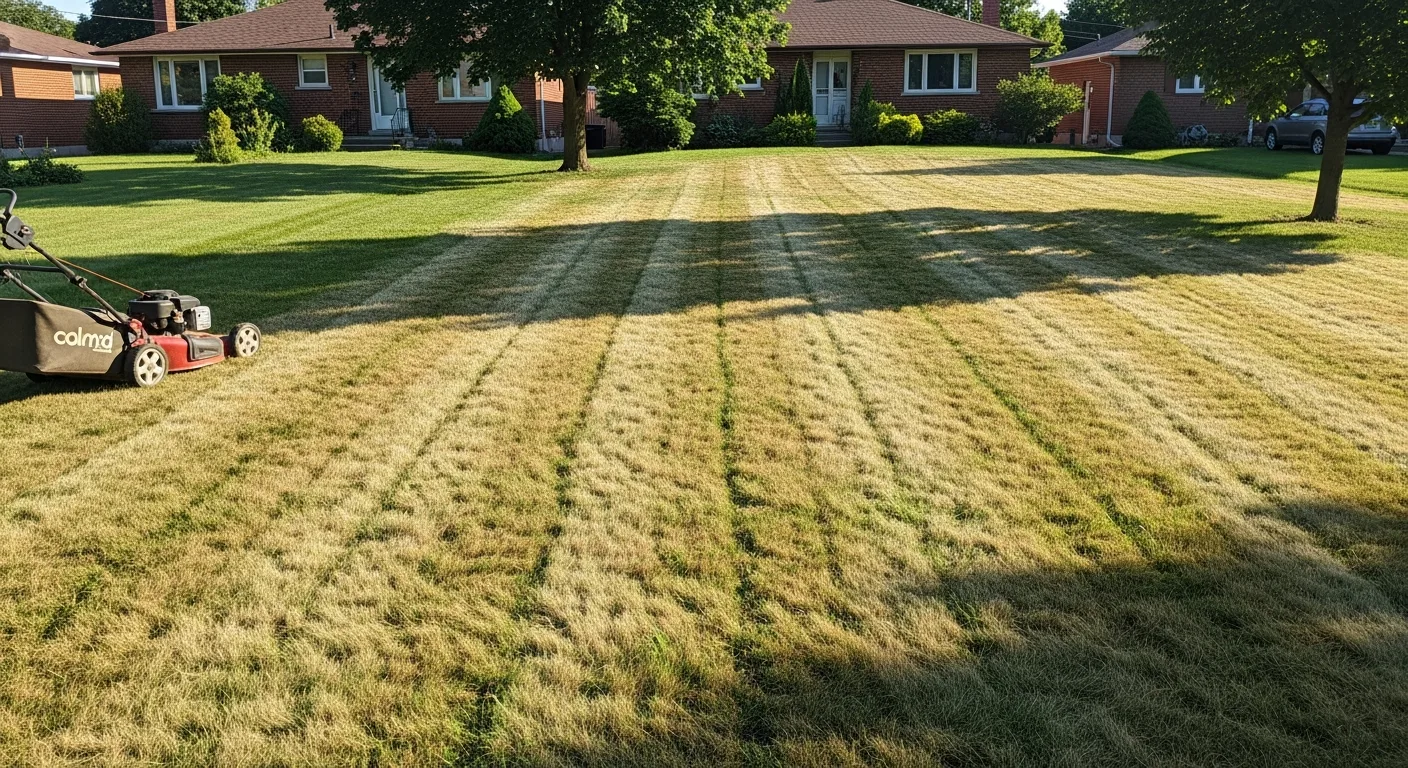
Scalping happens when your mower cuts so low that it removes the green photosynthetic blade and exposes the pale lower stem tissue — the crown — that lives below the cut zone. This tissue is white or yellow because it has never been exposed to sunlight; it has no chlorophyll. When suddenly exposed, it bleaches rapidly and gives your entire lawn a washed-out, yellow-brown appearance within 24 hours of mowing.
In a flat, perfectly even lawn, scalping only happens if your blade is set too low. But most Toronto residential lawns are not perfectly flat — they have subtle bumps from tree roots, frost heaving, and years of soil settling. A mower that is set at 2.5 inches will scalp any bump that rises more than half an inch above the average surface level. This creates the characteristic striped or spotted scalping pattern most homeowners recognize.
The fix is straightforward: raise your deck height to 3 inches. This is the minimum safe cutting height for GTA cool-season grasses. At 3 inches, your mower has enough clearance to pass over most terrain irregularities without exposing crown tissue. If scalping persists at 3 inches, your lawn needs levelling — a service your professional lawn care provider can assess.
The One-Third Rule — Why It Matters Every Single Mow
The one-third rule states: never remove more than one-third of the grass blade length in a single mowing. If your lawn is at 4.5 inches, your next cut should leave it no shorter than 3 inches. If your lawn grew to 6 inches while you were on vacation, cutting it back to 3 inches in one pass removes half the blade — a severe stress event that causes visible browning and sets back root growth by 1–2 weeks.
Practical implication: if you mow less frequently and your grass gets tall, mow at a higher setting first, wait 3–4 days, then cut to your target height. Two passes at the right height is always better than one scalping pass.
Problem 2: Dull Mower Blades — The Invisible Damage Source
A dull mower blade does not cut grass — it clubs it. Instead of slicing cleanly through the blade, a dull edge bends, compresses, and tears the grass fibre, leaving a ragged wound at the cut edge. The damaged tissue at the tip turns brown within 24–48 hours. When this happens to every grass blade on your lawn simultaneously, the result looks like your lawn is dying.
The visual test is simple: crouch down and look at a few grass blade tips the day after mowing. A sharp blade leaves a clean horizontal cut that dries to a uniform light tan at the tip. A dull blade leaves frayed, fibrous tips with irregular ragged edges. Under bright light, a scalped lawn will have visible brown haze that makes the overall lawn look dirty.
Residential mower blades should be sharpened every 20–25 hours of use — for a typical Toronto homeowner mowing weekly through a 26-week season, that is once a year at minimum, ideally twice (spring start and mid-season). Professional lawn care companies like Trim Gym sharpen commercial blades daily or every other day, which is a significant reason why professionally mowed lawns recover and green up faster than DIY-mowed properties.
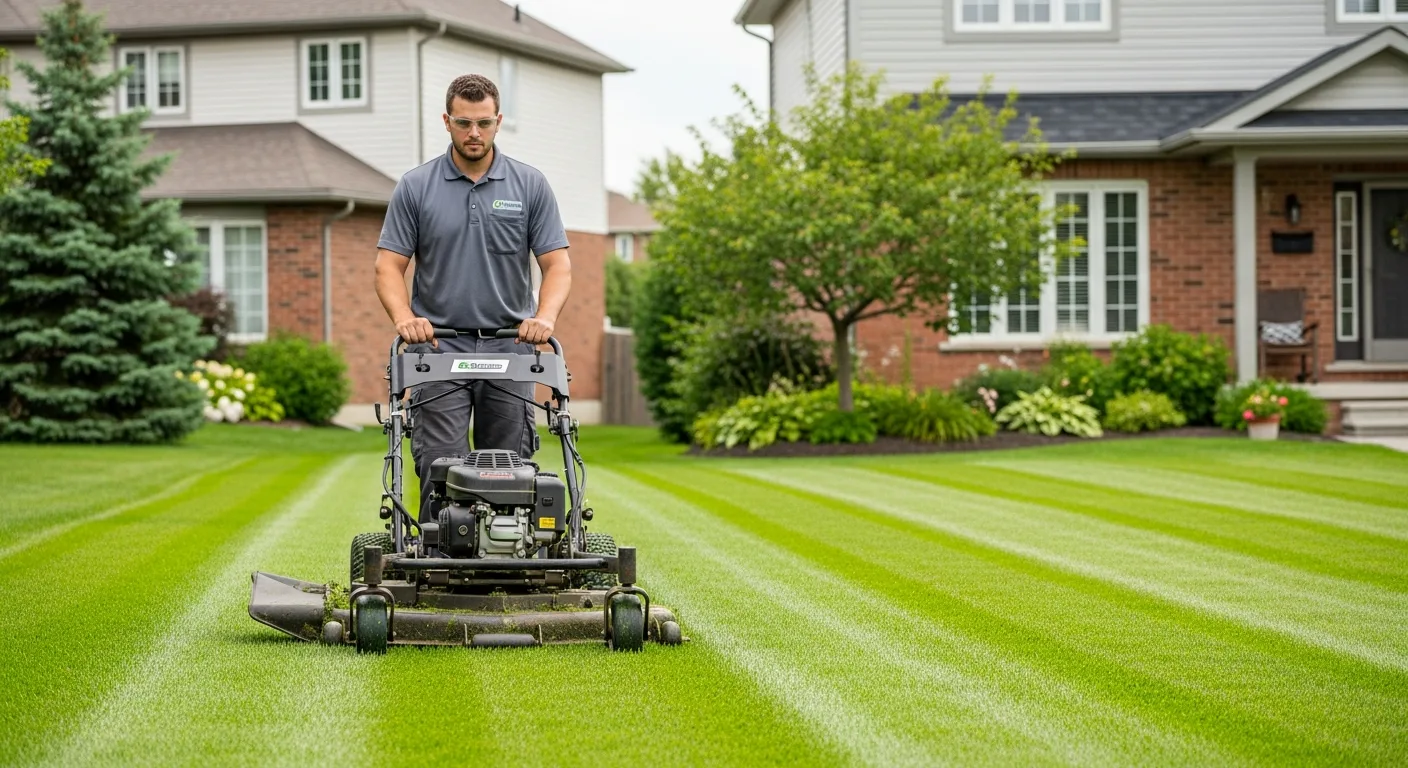
Commercial-grade mowers with freshly sharpened blades produce a clean surgical cut that leaves grass blades healing immediately, not tearing and browning.
Problem 3: Mowing Wet Grass — A Mistake That Creates Multiple Problems at Once
Mowing wet grass is something homeowners do when they are behind schedule and the grass needs cutting before it gets any longer. The logic is understandable — the result is not. Wet grass creates four distinct problems:
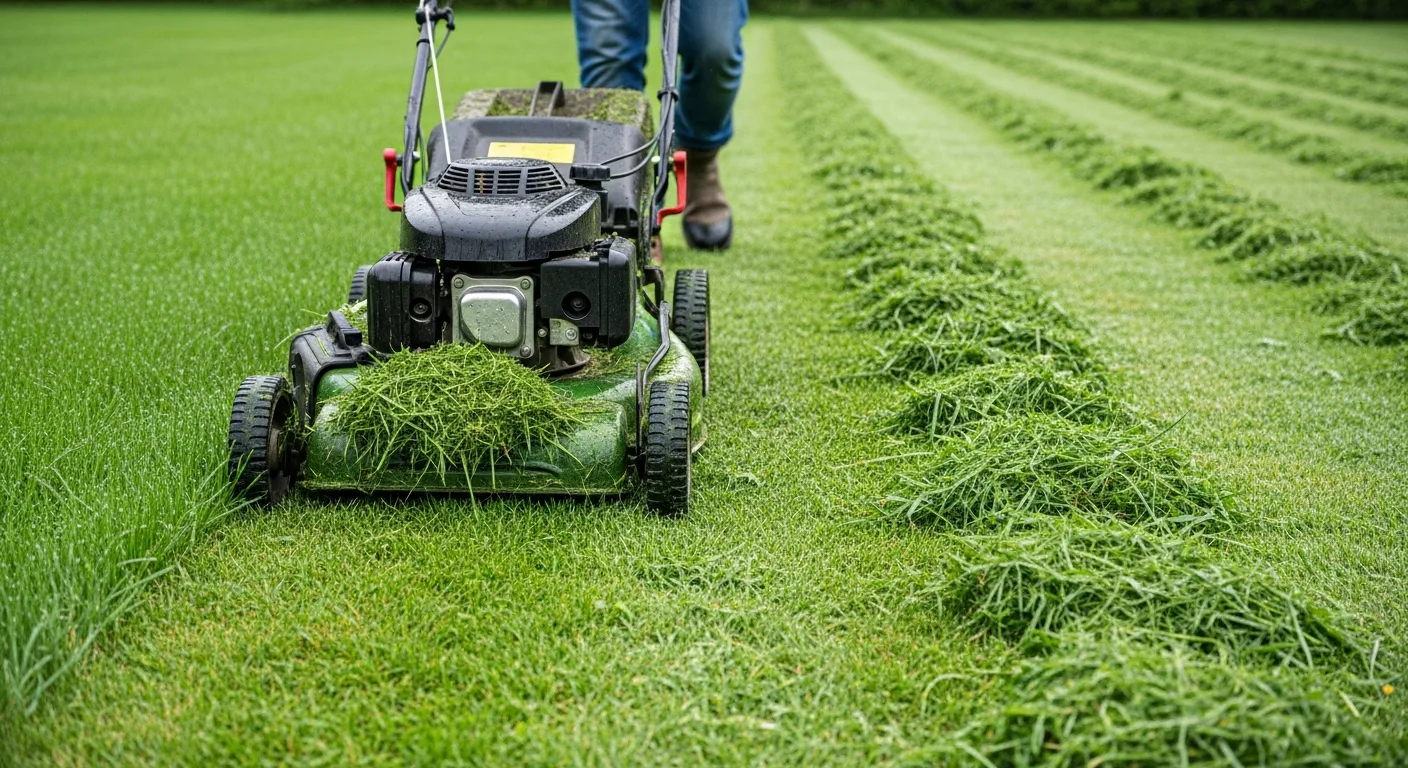
- Clumping and suffocation: Wet grass clippings stick together and discharge in dense clumps rather than dispersing evenly. These clumps sit on top of the lawn surface, block sunlight and airflow, and can kill the grass underneath if left for more than 24–48 hours. You will see yellow or brown rectangular patches underneath wherever a clump settled.
- Torn cuts: Wet grass blades are heavier and more pliable — they bend away from the blade rather than standing upright to be cut cleanly. The result is an uneven cut with torn edges, even with a sharp blade.
- Soil compaction and wheel ruts: GTA clay soil under wet conditions compresses easily under mower wheel weight. In severely wet conditions, you will see visible ruts along the mowing path. These compacted strips struggle to recover and become persistent thin zones in the lawn.
- Fungal disease spread: Cutting through wet grass and mulching wet clippings back into a damp lawn creates ideal conditions for fungal disease spread — particularly dollar spot, brown patch, and red thread. If your lawn consistently gets worse after wet mowing, fungal issues may be compounding the mechanical damage.
The rule is simple: wait until you can walk across the lawn without water spraying off the blades onto your shoes. For most Toronto summer mornings, that means waiting until after 9–10am — after dew has dried but before peak afternoon heat. Avoid mowing the day after significant rain.
Problem 4: Always Mowing in the Same Direction
Mowing the same route in the same direction every week causes grass blades to lean permanently in the direction of travel — a phenomenon called grain. Grained grass reflects light differently from the rest of the lawn, creating a striped or patchy appearance that homeowners sometimes mistake for disease or soil problems.
More importantly, always running your mower in the same direction compacts the soil in parallel strips under your wheel tracks. Over time, these compaction strips become the thin, struggling zones where weeds establish preferentially.
The fix is easy: rotate your mowing pattern by 90 degrees every week or two. Alternate between north-south and east-west passes. On a rectangular lawn, try diagonal passes occasionally. The visual difference is immediately noticeable — the lawn develops a uniform appearance instead of the uneven stripes caused by directional grain.
Problem 5: Mowing in Peak Heat
Mowing during the hottest part of the afternoon (12pm–4pm in GTA summers) stresses your grass at the moment it is already under maximum thermal load. When you cut a grass blade, the plant immediately mobilizes water to seal the wound and begins producing new tissue — a process that requires significant energy and water. Do this during peak heat, and the plant is simultaneously trying to cool itself and heal itself, with insufficient water pressure for both.
The visible result is a lawn that looks wilted, pale, and stressed within an hour of mowing — colours that can persist for 24–48 hours. The best mowing window in the GTA is mid-morning (8–11am) or early evening (5–7pm). Morning is slightly better because temperatures rise through the day, giving cut grass several hours to begin healing before peak afternoon heat.
Quick Diagnosis: Why Does My Lawn Look Bad After Mowing?
| What You See | Likely Cause | Fix |
|---|---|---|
| Overall yellow/pale colour across whole lawn | Scalping (blade too low) | Raise deck to 3"; wait 2 weeks to recover |
| Brown tips on every blade 24 hrs after mowing | Dull mower blade | Sharpen or replace blade immediately |
| Yellow/dead patches in irregular shapes | Wet clipping clumps left on surface | Never mow wet; rake clumps if already there |
| Uneven stripes, lawn looks "grainy" | Same direction every week | Rotate pattern 90° each mow |
| Wilted, pale appearance hours after mowing | Peak-heat mowing | Mow 8–11am or 5–7pm only |
| Brown straw-like appearance after mowing long grass | One-third rule violation | Mow at higher setting first; cut again in 4 days |
Frequently Asked Questions
How long does it take a scalped lawn to recover in Toronto?
A mildly scalped lawn (green tissue still present, just cut low) will recover in 7–14 days in spring or early fall growing conditions. Severely scalped areas where crown tissue was damaged may take 3–6 weeks or require overseeding if the crowns were killed. Stop mowing the affected area until it reaches 4 inches, water consistently, and apply a light nitrogen feed to accelerate recovery.
My lawn looks fine immediately after mowing but turns brown the next day. What's happening?
This is the classic dull blade symptom. A torn blade tip looks normal immediately after the cut because the wound is fresh. Over the next 12–24 hours, the damaged tissue at the torn tip browns and dies. When this happens to thousands of blades simultaneously, the overall lawn takes on a brown haze. Sharpen or replace your mower blade — this problem disappears immediately with a sharp blade.
Should I bag my grass clippings or mulch them back into the lawn?
For most Toronto lawns, mulching clippings back is better — clippings return nitrogen to the soil (equivalent to one fertilizer application per season) and reduce moisture loss. The exception is when you are mowing wet grass (clippings clump and smother) or when you have a disease outbreak (mulching spreads fungal spores). Under normal dry conditions, always mulch. Trim Gym mulches on every visit.
Is it worth switching to a professional lawn mowing service to fix these problems?
If the same mowing problems recur season after season — persistent scalping, slow recovery, yellow lawn — the answer is yes. Professional mowing with sharp commercial blades, correct timing, rotated patterns, and proper height makes a measurable difference in lawn appearance and health. The lawn you see on neighbours' properties that "just look better" almost always have professional service. Trim Gym's weekly service starts at $50/visit — for most Toronto homeowners, that math works out.
Tired of Your Lawn Looking Worse After Every Cut?
Trim Gym mows at exactly 3 inches, with blades sharpened for every route, always mulching, never in peak heat or wet conditions. The lawn you come home to looks better than it did before we arrived — every time.
All prices +HST. Cancel anytime. Serving GTA from May 1 – October 31.